
A lake city on the Sangamon since 1922
Concrete Contractors in Decatur, IL
Driveways, patios, steps and slab repair for a city of 35,000-plus homes, most of them long past their first pour.
- A free visit to measure, then a price on paper with every part of the job on its own line
- Stone base compacted under every outdoor slab, air-entrained ready-mix and saw-cut joints
- Permit and right-of-way questions answered for your address before a pour date is set
Concrete Work in a City Built Over a Century
Decatur is the center of our service area, and the concrete contractors work we do here is shaped by one fact more than any other: most of this city was already built a long time ago. Decatur held 66,269 people in 1950 and climbed to 93,939 by 1980. Since then it has shrunk, to 70,522 at the 2020 census. A city that stopped adding people more than forty years ago is a city of older driveways, older walks and older steps. Much of the concrete work here is replacing or repairing slabs that have already given decades of service.
What the housing numbers tell us
The 2020 census counted 35,430 housing units in Decatur, and 12.0% of them were vacant. Census QuickFacts puts the owner-occupied rate at 62.9%. With that many rentals and empty houses in the mix, the right job is often the one that fixes the real problem, not the most elaborate option. So we start every Decatur estimate by sorting what has to be replaced from what can be repaired:
- Cracked but level: routing and sealing cracks, then a penetrating sealer, can buy years
- Settled sections: a sunken walk square or step can sometimes be lifted rather than torn out
- Broken, heaved or scaling throughout: this is where full Concrete Repair & Replacement pays off
- Rental and vacant homes: owners getting a house ready to rent or sell often need a safe, clean walk and steps more than anything decorative
Lake Decatur and the Sangamon
Lake Decatur was finished in 1922 by damming the Sangamon River. It was the largest artificial lake in Illinois when it was built, and its shoreline ran about 30 miles. Water covers 4.68 of the city's 47.79 square miles, about 10%. Wherever a lot sits low, whether near the lake or not, we look at where downspouts empty and where water goes after a storm. A new driveway or patio should carry water away from the house, and on low, wet ground that can mean a different pitch or a thicker compacted stone base than the same slab would need on high ground.
Built for central Illinois winters
Under the 1991 to 2020 normals for Decatur, January nights average 19.7°F, and the record low is -25°F. The city gets about 40.44 inches of precipitation and 13.6 inches of snow in an average year. Water in the pores of a slab freezes, expands and thaws again many times each winter. That cycle is what pops the surface off older, non-air-entrained concrete and leaves the rough, flaking look you see on a lot of Decatur steps and aprons. Every exterior slab we pour uses an air-entrained mix, gets proper control joints and is cured before it sees traffic. We also ask you to skip rock salt the first winter and use sand for traction instead.
Old neighborhoods, many kinds of lots
The city's Department of Community Development mapped 71 official neighborhoods in 1999, and the housing in them spans more than a century. On Millikin Place, the Edward P. Irving House was built in 1911 to a Frank Lloyd Wright design. Older homes often have detached garages, long walks and front steps that have been patched more than once. Later houses tend to have attached garages and wider aprons. The same six services fit both, but the job looks different:
- Concrete Driveways: a full tear-out and repour, with a 4-inch slab for cars and a thicker slab where a truck or camper parks
- Concrete Patios: plain broom finish or a backyard slab sized for a grill and table
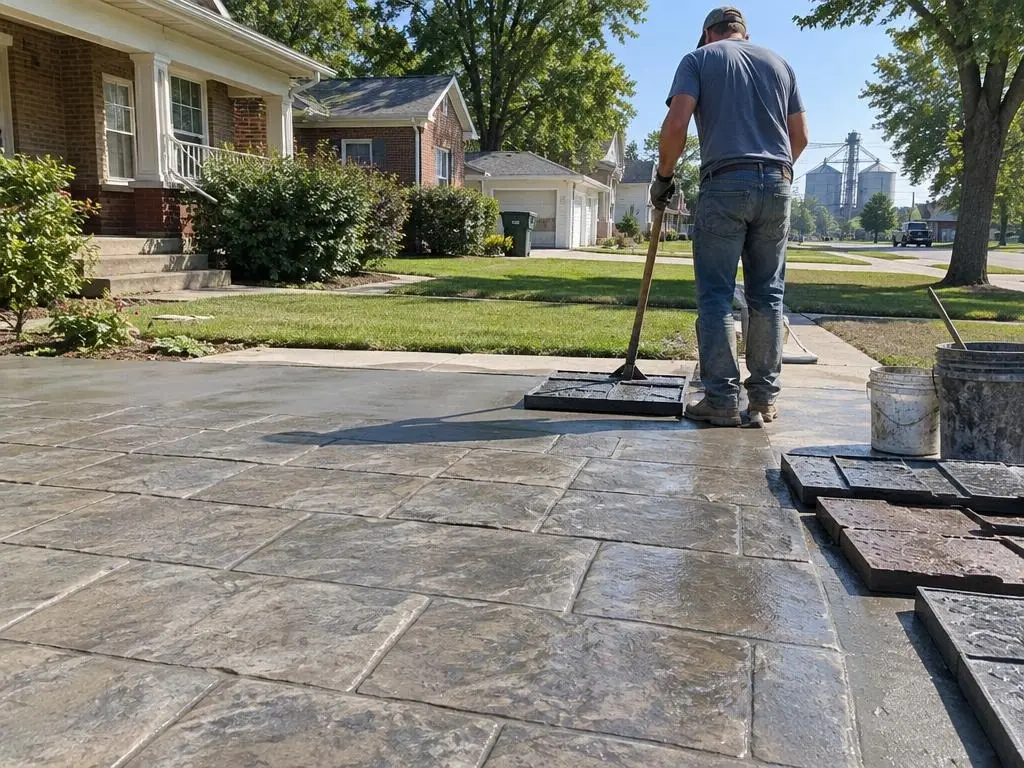
- Stamped Concrete: patterned and colored surfaces for patios and walk borders, sealed after the pour
- Sidewalks & Steps: front walks, side paths and step replacements with a proper landing
- Garage & Shed Slabs: detached garage floors, which in older parts of town are often the most worn slab on the lot
- Concrete Repair & Replacement: section-by-section fixes when a whole slab does not need to go
Decade by decade
Point2Homes, summarizing Census survey data, breaks Decatur's homes down by when they were built: 22.8% in 1939 or earlier, 9.1% in the 1940s, 18.4% in the 1950s, 13.6% in the 1960s and 15.6% in the 1970s. Only 3% went up in the 2000s and 1.4% in the 2010s. Each era leaves different concrete behind. Pre-war houses tend to have narrow drives to a detached garage and stoops that have been patched over and over. Post-war ranches often have a single slab driveway with no cut joints and a small back patio poured against the foundation. 1970s homes usually have wider attached-garage drives that are now reaching the age where aprons drop and surfaces scale. Knowing roughly when your house was built tells us what to look for under the old slab before we price anything.
Why repair often comes first here
In a city with this much older concrete, not every problem needs a new slab. One heaved square of walk next to a tree, one sunken step, a crack across a garage apron: these are common, and they can often be handled as single repairs. When we look at your concrete, we tell you plainly whether repair will last or whether you would be spending money twice. Call (217) 301-2983 or ask for an estimate and we will come look.
Decatur Facts That Shape Concrete Work
- A shrinking, older city. Decatur peaked at 93,939 residents in 1980 and counted 70,522 in 2020, so much of its concrete dates from earlier decades.
- Housing stock. The 2020 census counted 35,430 housing units, 12.0% vacant; QuickFacts lists a 62.9% owner-occupied rate.
- Lake Decatur. The Sangamon River was dammed to form Lake Decatur, finished in 1922 with about 30 miles of shoreline.
- Hard winters. January nights average 19.7°F under 1991-2020 normals, with a record low of -25°F and about 13.6 inches of snow a year.
- 71 neighborhoods. The city's Department of Community Development mapped 71 official neighborhoods on July 19, 1999.
Decatur Questions
Should I repair or replace my Decatur driveway?
If the slab is level and the cracks are narrow, sealing and repair can make sense. If it has sunk, heaved, or flaked across most of its surface, replacement is usually the better use of your money. We look at the base and drainage before giving you a recommendation.
Do I need a permit for a driveway or sidewalk in Decatur?
Work in the public right-of-way, such as the city sidewalk, curb or driveway apron, can need city approval. We check with the City of Decatur for your address before we schedule the work.
Why is the surface of my old steps flaking off?
That is called scaling. It happens when water in the surface freezes and thaws over many winters, and deicing salt makes it worse. New steps poured with air-entrained concrete and kept free of salt the first winter hold up much better.
Free Estimates in Decatur, IL
Free estimates anywhere in Decatur, from the lake to the north side.
Concrete Contractors Near Decatur
- Concrete Contractors in Mount Zion, IL
- Concrete Contractors in Forsyth, IL
- Concrete Contractors in Long Creek, IL
- Concrete Contractors in Maroa, IL
- Concrete Contractors in Clinton, IL
- Concrete Contractors in Monticello, IL
- Concrete Contractors in Argenta, IL
- Concrete Contractors in Oreana, IL
- Concrete Contractors in Warrensburg, IL
- Concrete Contractors in Harristown, IL
- Concrete Contractors in Niantic, IL
- Concrete Contractors in Macon, IL
- Concrete Contractors in Blue Mound, IL
- Concrete Contractors in Moweaqua, IL
- Concrete Contractors in Cerro Gordo, IL
- Concrete Contractors in Bement, IL
- Concrete Contractors in Sullivan, IL
- Concrete Contractors in Assumption, IL
- Concrete Contractors in Dalton City, IL
- Concrete Contractors in Bethany, IL
- Concrete Contractors in Illiopolis, IL